Why Plant-Based Protein Needs Different Spacing Through the Day
Quick Answer: Plant proteins generally contain less leucine per gram than animal proteins, and leucine is the main trigger for muscle protein synthesis. That means a plant-based eater needs a somewhat larger protein dose per meal to cross the same threshold, which in practice means fewer, larger protein servings spread across three to four meals rather than a large total eaten unevenly. Hitting a daily total while eating most of it at dinner leaves several windows where the threshold was never reached.
The fix is usually redistribution rather than more food, which is why people often feel better without eating more.
This is general information, not medical or nutritional advice.

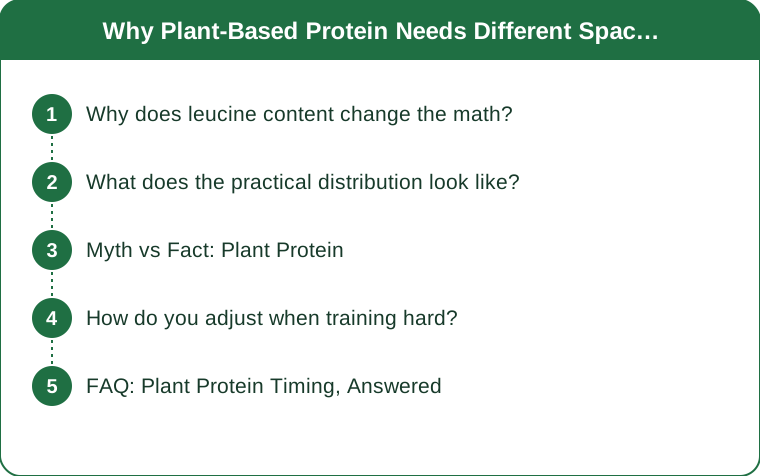
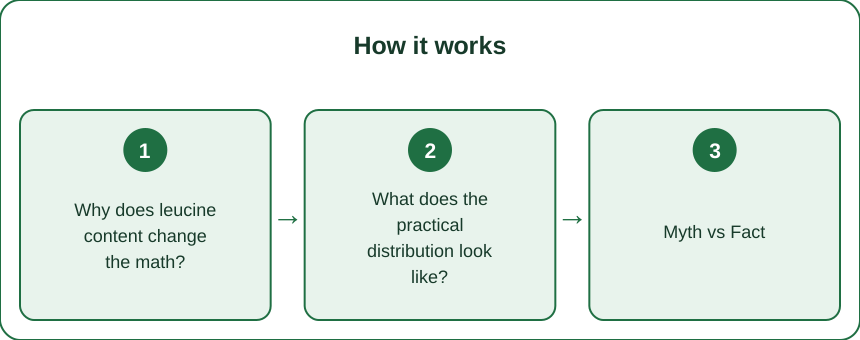
Why does leucine content change the math?
Because muscle protein synthesis responds to a threshold, not to a running total.
Eating protein triggers a synthesis response, but only once the amino acid leucine reaches a certain concentration in the blood. Below that threshold, the protein is still used — for tissue repair, enzymes, and energy — but the anabolic signal is not fully switched on.
Animal proteins typically contain around 8 to 11 percent leucine by weight. Most plant proteins sit lower, commonly in the 6 to 8 percent range, with the notable exception of soy, which is close to animal sources.
The practical consequence is that a 20-gram serving of animal protein may cross the threshold while a 20-gram serving of many plant proteins does not quite. The commonly cited adjustment is aiming for roughly 25 to 40 grams of plant protein per meal rather than 20 to 25.
There is a second factor: digestibility. Plant proteins are packaged in cell walls and often accompanied by fiber and antinutrients that reduce how much is actually absorbed. Cooking, soaking, sprouting, and fermenting all improve this meaningfully, which is why the traditional preparations for legumes exist.
None of this means plant protein is inadequate. It means the serving size and the spacing need to be different, which is a planning issue rather than a nutritional limitation.
What does the practical distribution look like?
Three or four meals, each carrying a real protein dose, rather than one large one.
Breakfast is where most plant-based eaters fall short. A bowl of oats with fruit is a fine meal that contains perhaps 8 grams of protein. Adding soy milk, a scoop of protein powder, hemp seeds, or a side of tofu brings it to 25 or 30, which changes the whole day.
Lunch tends to be moderate — a grain and legume bowl typically lands between 15 and 25 grams. Increasing the legume portion or adding tempeh or edamame closes the gap.
Dinner is usually the largest, and for many people it carries half the day’s protein alone. That is the meal that does not need changing.
A fourth eating occasion helps more on a plant-based diet than an omnivorous one, because it creates another opportunity to cross the threshold. Soy yogurt, edamame, a protein shake, or roasted chickpeas all work.
A reasonable target structure for an active adult: roughly 30 grams at each of three main meals plus 15 to 20 at a snack. The total is not dramatically higher than a standard recommendation — it is simply arranged differently, and that arrangement is what most people are missing when they report feeling under-fueled despite hitting their numbers.

Myth vs Fact: Plant Protein
Myth: You must combine proteins at every meal. Fact: The complementary protein theory as originally stated has been walked back. Your body maintains an amino acid pool across the day, so eating varied plant proteins across meals is sufficient. Variety over a day matters; precise pairing at each meal does not.
Myth: Plant protein is inferior. Fact: It is less concentrated and lower in leucine, which changes portion size. Across a well-planned diet, outcomes for strength and muscle are comparable when total protein and distribution are matched.
Myth: Soy is a problem for hormones. Fact: The research in humans consistently does not support meaningful hormonal disruption at normal dietary intakes, and soy is among the most complete plant proteins available. It is one of the more useful foods in this context.
Myth: Protein powder is unnecessary if you eat well. Fact: It is not necessary, but on a plant-based diet it is a practical way to hit per-meal thresholds without eating an impractical volume of food. A pea-rice blend covers the amino acid profile well.
Myth: More fiber is always better. Fact: The fiber that accompanies plant protein is generally beneficial, but very high intakes can limit total food volume, particularly for people with higher energy needs. Some refinement — tofu over whole soybeans, for instance — is a legitimate tool rather than a compromise.
How do you adjust when training hard?
Increase per-meal amounts before increasing meal frequency.
For someone doing regular resistance training, the commonly cited target is roughly 1.6 to 2.0 grams of protein per kilogram of body weight daily, and the higher end of that range is often suggested for plant-based eaters to account for digestibility and leucine differences.
Post-training is the meal most worth getting right. A 30 to 40 gram plant protein dose within a couple of hours of training is the version most likely to be limiting. Soy and pea protein are the best choices here specifically because of their leucine content.
Do not neglect total energy. Plant-based diets are naturally high in volume and fiber, which is satiating. Active people frequently under-eat total calories without intending to, and inadequate energy makes protein less effective regardless of how well it is distributed.
Watch the supporting nutrients too. Vitamin B12 requires supplementation on a fully plant-based diet. Iron, zinc, iodine, and omega-3 all warrant attention, and iron in particular affects training capacity directly. Pairing iron-rich plant foods with vitamin C substantially improves absorption.
And give any change six to eight weeks. Energy and recovery changes from redistribution are usually noticeable within two to three weeks, but strength and body composition changes take longer.
This is general information, not medical advice. A registered dietitian is the right person to individualize this, particularly if you have higher needs or any medical condition.
FAQ: Plant Protein Timing, Answered
Does it matter if one meal is low in protein?
One is fine. A pattern where two of three meals are low is where the effect becomes meaningful, because those windows never reach the synthesis threshold at all.
Is the leucine threshold a hard cutoff?
No, it is a gradient rather than a switch. Getting close still produces a response; the point is that plant-based portions need to be somewhat larger to get the same effect, not that a slightly smaller portion does nothing.
Should I eat protein before bed?
A pre-sleep dose of 30 to 40 grams has reasonable support for overnight muscle protein synthesis. Soy protein or soy yogurt works well for this and is easy to digest.
This is general information, not medical advice.
TL;DR:
- Plant proteins are lower in leucine, so each meal needs roughly 25 to 40 grams rather than 20 to 25.
- Muscle protein synthesis responds to a per-meal threshold, not a daily total.
- Breakfast is where most plant-based eaters fall short — fix that meal first.
- Add a fourth eating occasion, prioritize soy or pea protein after training, and supplement B12.
Add up the protein in your usual breakfast. For most plant-based eaters that single number explains the whole problem.
This is general information, not medical advice.
Keep Reading
This article is for general informational purposes only and is not medical advice. Always consult a qualified health professional for guidance specific to you.