Why Does Going Plant-Based Make Some People Feel the Cold More?
Quick Answer: Feeling colder after switching to a plant-based diet usually traces to one of three things: a lower total energy intake because plant foods are less calorie-dense, low iron status affecting oxygen delivery and thermoregulation, or insufficient protein and thyroid-relevant nutrients. All three are addressable within the diet, and none of them are inevitable consequences of eating plants.
You made the switch in spring and felt great.
Then October arrived and you are the coldest person in the room.
This is general information, not medical advice.

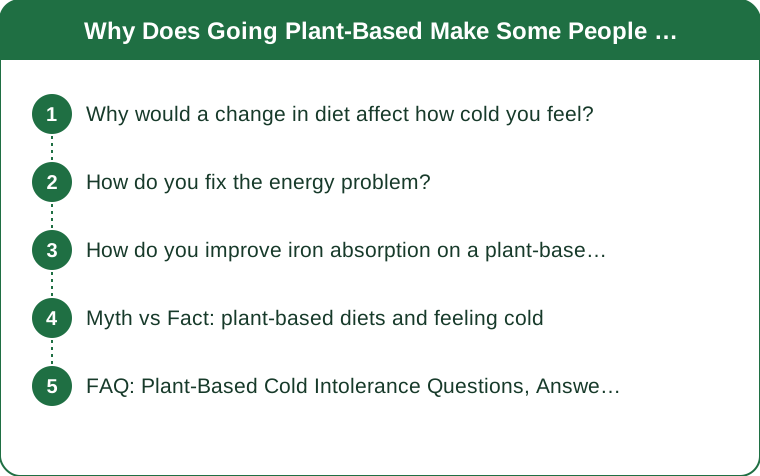
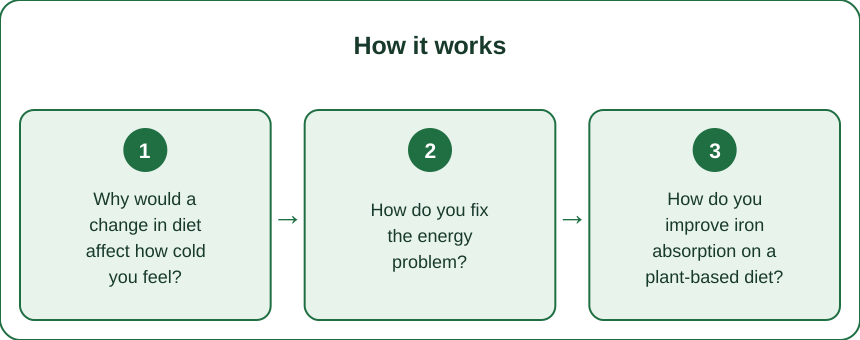
Why would a change in diet affect how cold you feel?
Because body heat is metabolic output, and several dietary factors feed into it.
Total energy intake is the biggest one. Plant foods are typically less energy-dense than animal foods — more volume, more fibre, fewer calories per mouthful. People switching to a plant-based diet frequently eat less energy without intending to, simply because they fill up sooner.
A sustained energy deficit reduces resting metabolic rate over time, and one of the first things people notice when running low is feeling cold. This is well documented in the context of dieting generally, and it is not specific to plant-based eating — it just happens more easily when the food is bulkier.
Iron status is the second. Iron is essential for haemoglobin, which carries oxygen to tissue, and oxygen delivery underpins heat production. Low iron is associated with cold intolerance, and it is one of the more commonly reported symptoms of deficiency.
Plant-based diets provide non-haem iron, which is absorbed less efficiently than the haem iron in meat. Total intake can look adequate on paper while absorbed iron is lower than it appears.
Thyroid-relevant nutrients are the third. Thyroid hormones regulate metabolic rate directly. Iodine and selenium are both required, and both can be lower in plant-based diets depending on food choices — iodine particularly, since dairy and fish are major sources for many people.
Is this a sign the diet is not working?
Not at all. It is a sign that something specific needs adjusting, and all three of the likely causes have straightforward dietary fixes.
How do you fix the energy problem?
By deliberately increasing energy density, particularly as the weather cools.
The practical issue is volume. A plant-based meal that fills you completely may contain considerably less energy than the equivalent-feeling meal did before, and appetite adapts more slowly than the diet changes.
Add fat sources deliberately. Nuts, seeds, nut butters, tahini, avocado, and olive oil are the most efficient way to raise energy density without raising volume. A spoonful of tahini on roasted vegetables or a handful of walnuts on a salad adds meaningful energy for very little bulk.
Do not fear the starchy component. Potatoes, rice, pasta, bread, and oats are energy-dense and satisfying. Plant-based eating built mainly around vegetables and salad is the version most likely to leave people under-fuelled and cold.
Eat more frequently in cold weather. Cold environments increase energy expenditure, and appetite does not always track it. Adding a substantial snack in the afternoon is often enough on its own.
Shift toward cooked and warm foods. Beyond the psychological comfort, warm meals are easier to eat in larger quantities than cold ones, and autumn appetite generally suits soups, stews, and roasted food better than summer salads.
Check your portions honestly. Many people switching to plant-based eating keep the same portion sizes and end up eating substantially less energy without noticing.
How would I know if energy is the problem?
Other signs of under-fuelling usually accompany it — persistent tiredness, poor training performance, disrupted sleep, low mood, or for some people changes in menstrual regularity. Cold intolerance rarely arrives alone.

How do you improve iron absorption on a plant-based diet?
The intake matters less than the absorption, and absorption is highly manipulable.
Pair iron sources with vitamin C. This is the single most effective adjustment. Vitamin C substantially increases the absorption of non-haem iron when eaten in the same meal. Practically: peppers, tomatoes, citrus, berries, or broccoli alongside lentils, beans, tofu, or fortified cereal. A squeeze of lemon over a lentil dish is doing real work.
Separate tea and coffee from meals. Polyphenols in tea and coffee inhibit non-haem iron absorption significantly. Drinking them an hour either side of a meal rather than with it is a straightforward change with a measurable effect. This one catches a lot of people, because a cup of tea with dinner is such an ingrained habit.
Know your best sources. Lentils, chickpeas, beans, tofu, tempeh, pumpkin seeds, fortified cereals, and dark leafy greens. Tofu in particular is often underestimated.
Soak, sprout, or ferment where practical. These processes reduce phytate content, which improves mineral absorption. Sourdough bread, sprouted pulses, and tempeh all benefit from this.
Cook in cast iron. A modest and real contribution, particularly for acidic foods.
Get it tested rather than guessing. Iron supplementation without knowing your status is not advisable — excess iron is harmful, and the symptoms of low iron overlap with many other things. A blood test including ferritin is the way to find out.
What about B12?
B12 is not optional on a plant-based diet — reliable sources are fortified foods or a supplement. Deficiency causes fatigue and neurological symptoms and develops slowly enough that people often miss it. This is separate from the cold question and more important than it.
Myth vs Fact: plant-based diets and feeling cold
Myth: Humans need meat to stay warm. Fact: Heat production comes from energy metabolism, not from any particular food source. Plenty of people eat plant-based diets in cold climates without difficulty. The variables are energy, iron, iodine, and protein — all obtainable from plants with attention.
Myth: Feeling cold means the diet is nutritionally inadequate by definition. Fact: It means something specific is low. A well-planned plant-based diet is considered nutritionally adequate by major dietetic bodies; a poorly planned one, like a poorly planned omnivorous one, is not.
Myth: Protein is the main issue. Fact: Protein needs are usually met with reasonable planning, and total energy is more often the culprit. Protein still matters — spread across the day, from varied sources — and it is rarely the primary explanation for cold intolerance.
Myth: Eating more spicy food helps. Fact: Capsaicin produces a brief warming sensation and a small thermogenic effect. It is not a substitute for adequate energy intake.
Myth: It will resolve on its own as you adapt. Fact: If the cause is low iron or insufficient energy, it does not resolve by waiting, and low iron in particular tends to worsen over months.
Myth: Everyone gets cold on plant-based diets. Fact: Many people report no change or feel better. Where it happens, it is a signal about a specific gap rather than a feature of the diet.
FAQ: Plant-Based Cold Intolerance Questions, Answered
How long should I give it before investigating?
If it persists more than a few weeks, particularly alongside fatigue, it is worth acting on rather than waiting. Low iron develops gradually and is easier to address earlier.
What blood tests are useful?
Full blood count, ferritin, B12, and thyroid function cover the most likely explanations. Ask your GP rather than self-directing supplementation.
Do I need an iodine supplement?
It depends entirely on your diet and where you live. Seaweed is a source and highly variable in content — some varieties provide extremely high amounts. Iodised salt and fortified plant milks are more predictable. This is worth discussing with a dietitian rather than guessing, as both too little and too much cause problems.
Does this affect exercise performance too?
Low iron affects endurance performance measurably, and under-fuelling affects everything. If both cold intolerance and declining training performance appeared together, that combination points fairly clearly at one of these two causes.
Is it worse in the first year?
Often, yes — iron stores deplete over months, so the effect of reduced absorption shows up some time after the dietary change rather than immediately. A first autumn is a common time to notice it.
Should I add some animal products back?
That is your decision, and it is not the only option available. Most people find the specific gap is addressable within a plant-based diet once identified.
TL;DR:
- Feeling cold after switching usually means low energy intake, low iron, or a thyroid-relevant nutrient gap.
- Plant foods are bulkier and less energy-dense, so people often under-eat without realizing.
- Add fats and starches deliberately, and eat more frequently as the weather cools.
- Pair iron sources with vitamin C and keep tea and coffee away from meals — absorption matters more than intake.
- Get iron, B12, and thyroid checked rather than supplementing blind.
It is a signal about a specific gap, not a verdict on the diet. All three likely causes are fixable without changing what you eat in principle.
This is general information, not medical advice. Discuss persistent symptoms and any supplementation with a GP or registered dietitian.
Keep Reading
This article is for general informational purposes only and is not medical advice. Always consult a qualified health professional for guidance specific to you.