Why Plant-Based Meals Need More Fat Than You Are Giving Them
Quick Answer: Vitamins A, D, E and K, plus carotenoids like beta-carotene and lycopene, are fat-soluble — they need dietary fat in the same meal to cross the gut wall. A large salad eaten with a fat-free dressing can deliver a fraction of the carotenoids that the same salad delivers with a couple of tablespoons of oil, nuts, or avocado. On a plant-based diet, where these nutrients come almost entirely from vegetables, that gap compounds meal after meal.
You are eating better than almost anyone you know. Enormous salads, dark leafy greens, peppers, tomatoes, sweet potato, the full colour spectrum.
And you are still tired, your skin is dry, and your last set of bloods was not as impressive as your shopping basket suggested it should be.
The problem may not be what is on the plate. It may be what is missing from it — because a significant share of what makes those vegetables valuable simply does not get through without fat alongside it.
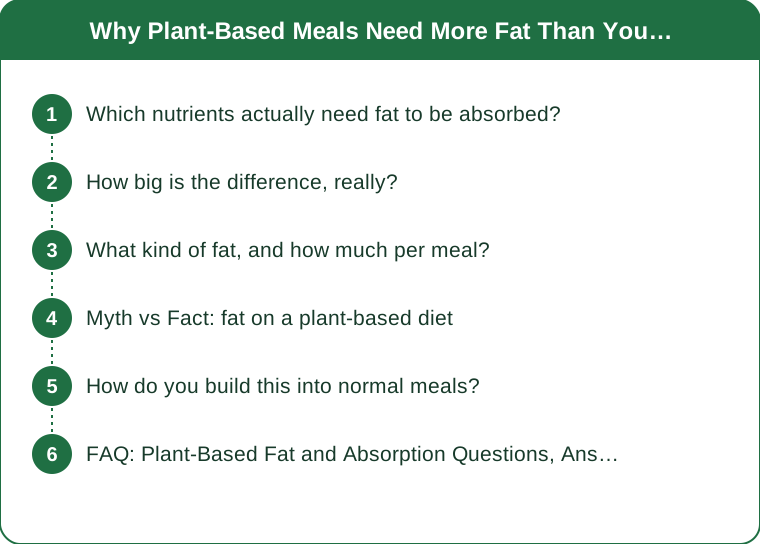
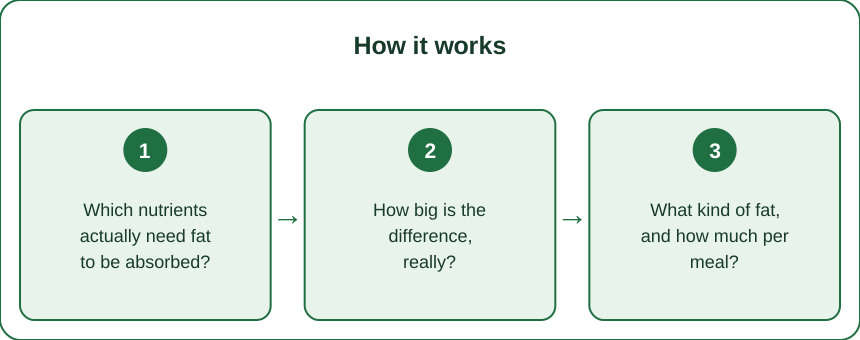
Which nutrients actually need fat to be absorbed?
Four vitamins and a whole family of plant pigments, and on a plant-based diet you rely heavily on all of them.
The fat-soluble vitamins:
- Vitamin A — on a plant-based diet you get this as beta-carotene from carrots, sweet potato, and dark greens, which your body converts. Both the absorption and the conversion are fat-dependent.
- Vitamin D — mostly from sun and supplements rather than food, but the supplement itself absorbs better with a meal containing fat.
- Vitamin E — from nuts, seeds, and oils, which conveniently arrive with their own fat.
- Vitamin K — abundant in leafy greens, and K1 from greens is notoriously poorly absorbed without fat.
The carotenoids, which are not vitamins but matter enormously:
- Lycopene from tomatoes
- Lutein and zeaxanthin from dark greens, associated with eye health
- Beta-carotene from orange and dark green vegetables
Why the plant-based angle is specific: an omnivorous diet tends to deliver these nutrients alongside fat automatically — dairy fat, egg yolk, fatty fish. A plant-based plate built around vegetables, grains, and legumes can be genuinely low in fat unless you add it deliberately, and the vegetables are simultaneously your only source of these nutrients.
How big is the difference, really?
Large enough that it changes what the meal is worth.
Research on carotenoid absorption has repeatedly shown that adding fat to a vegetable meal multiplies the amount absorbed rather than nudging it. The effect is most dramatic with fat-free versus full-fat dressing on salads, where absorption of several carotenoids increases several-fold.
The practical translation: a large mixed salad with a fat-free vinaigrette can deliver a small fraction of the carotenoids that the identical salad delivers with a proper oil-based dressing. You ate the same vegetables. You did not receive the same nutrition.
Three things determine how much gets through:
- How much fat is present — there is a rising benefit up to a point, after which more fat adds little. The commonly cited useful range is roughly 3 to 5 grams of fat minimum, with benefits continuing up to somewhere around 15 to 20 grams for a large vegetable meal.
- Whether the fat is in the same meal — it needs to be eaten together, not an hour later.
- How the vegetable was prepared — cooking, chopping, and blending break down cell walls and release far more carotenoid than raw whole vegetables.
The compounding effect is the real issue. One under-absorbed salad does not matter. Two vegetable-based meals a day for months, each delivering a fraction of what it should, is a genuine long-term shortfall.
What kind of fat, and how much per meal?
Whole-food fats do the job and bring their own nutrition with them.
Good options, roughly by convenience:
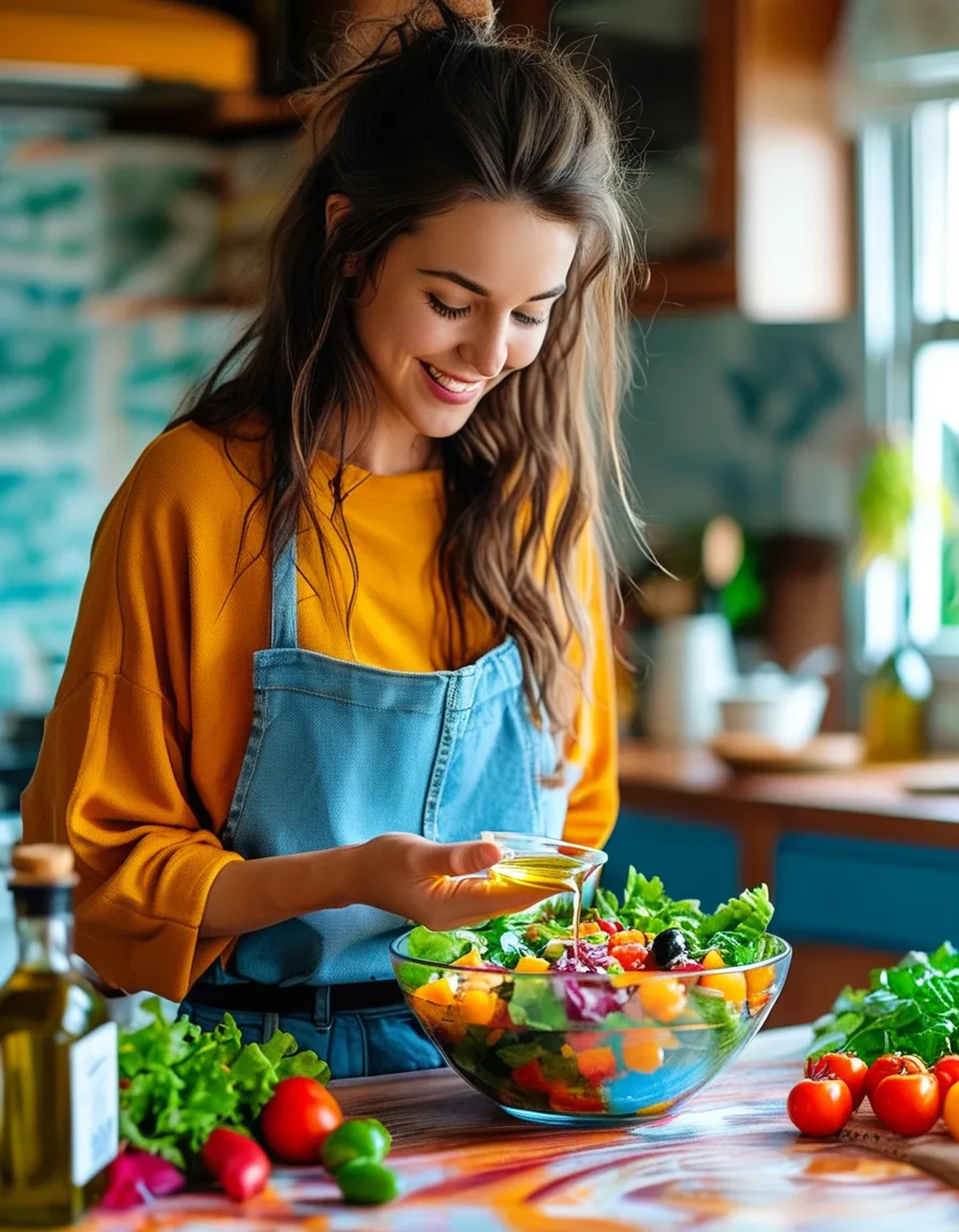
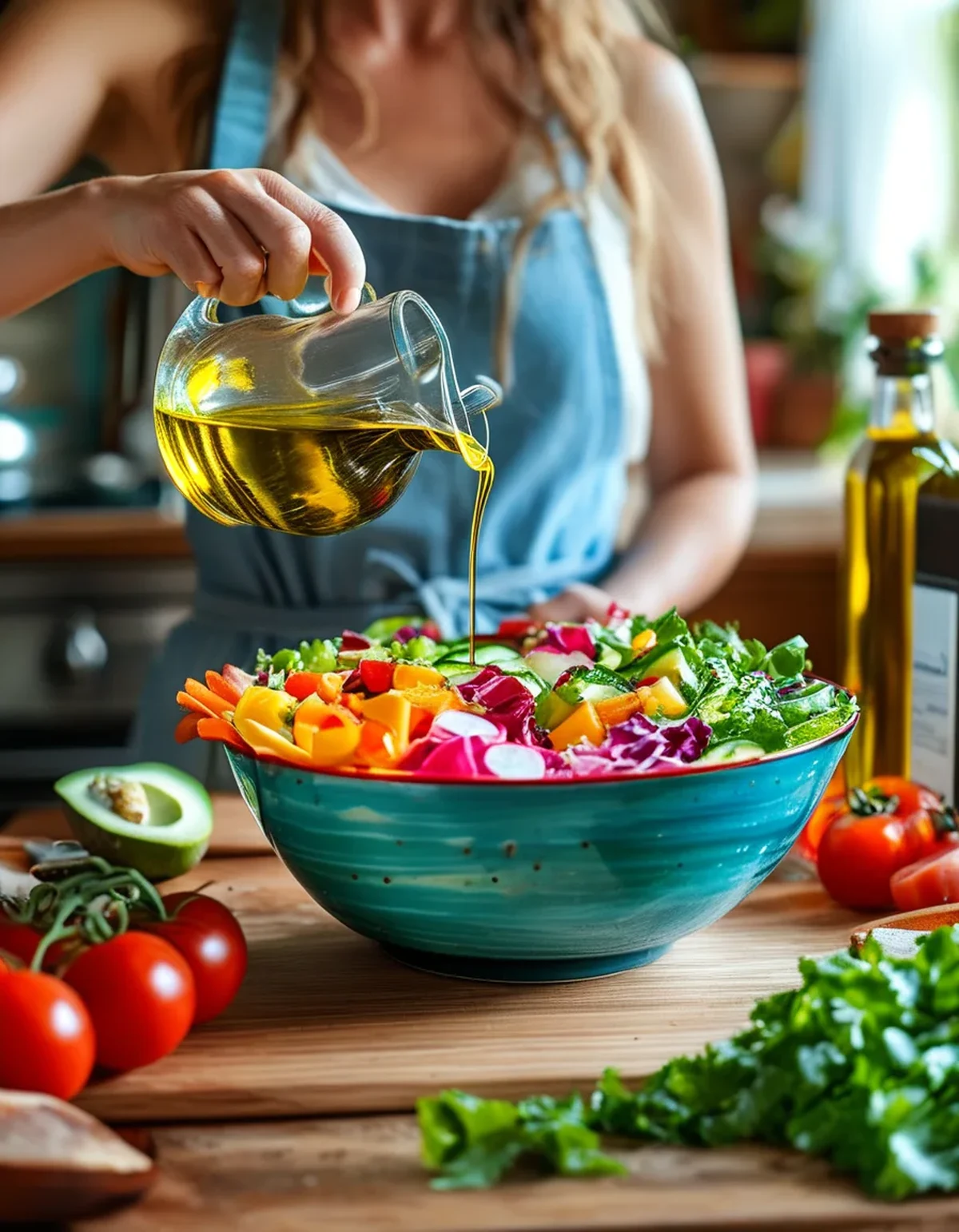
- Extra virgin olive oil — 1 to 2 tablespoons on a salad. The most studied and the most reliable.
- Avocado — a quarter to a half. Has been shown specifically to boost carotenoid absorption from meals eaten alongside it.
- Nuts and seeds — a small handful, around 30g. Walnuts, almonds, pumpkin seeds. Adds protein and minerals too.
- Tahini or nut butter — excellent in dressings, and gets fat evenly distributed through the meal rather than sitting in one corner.
- Whole olives — a modest portion adds fat and salt together, which helps vegetables taste like something.
A workable target: aim for roughly 10 to 15 grams of fat in any meal built around vegetables. That is about a tablespoon of oil, or a third of an avocado, or 20g of nuts.
Where people go wrong:
- Fat-free dressings on principle. These were designed for a calorie-focused era and they actively work against the nutrition of the salad.
- Adding fat as a side rather than mixed in. Oil tossed through a salad contacts everything; a spoonful of nuts on top contacts less. Both work, mixing works better.
- Steamed vegetables with nothing on them. Plain steamed greens are the classic under-absorbed meal. A drizzle of oil at the end changes what you get from them.
Myth vs Fact: fat on a plant-based diet
Myth: Low-fat plant-based is the healthiest version of plant-based. Fact: Very low-fat approaches have their advocates and their evidence, but they require deliberate attention to fat-soluble nutrient status. Cutting fat below the level needed for absorption does not make a vegetable-rich diet healthier — it makes some of the vegetables ornamental.
Myth: You will get enough fat incidentally from whole grains and legumes. Fact: Whole grains and legumes contain some fat, but usually only a few grams per serving, and it is not always in the same meal as your vegetables. It is easy to build a genuinely low-fat plant-based day without noticing.
Myth: Raw is always better than cooked for vegetables. Fact: For carotenoids, cooking usually increases what you can absorb, because heat breaks down cell walls. Cooked tomatoes deliver considerably more usable lycopene than raw ones. Vitamin C goes the other way, which is why a mix of raw and cooked beats either extreme.
Myth: If your diet is varied enough, absorption looks after itself. Fact: Variety fixes the range of nutrients you take in. It does nothing about whether they cross the gut wall. Those are two separate problems and they need two separate solutions.
How do you build this into normal meals?
Small, permanent habits beat remembering to do something clever.
Breakfast
- Add ground flaxseed or a spoon of nut butter to porridge or smoothies. Also covers your omega-3 base.
- If you take a vitamin D supplement, take it with this meal rather than on an empty stomach.
Lunch — usually the weakest meal
- Always dress the salad properly. Olive oil and vinegar, or a tahini-lemon dressing. Never fat-free.
- Add avocado or a handful of seeds by default rather than as a treat.
Dinner
- Finish cooked vegetables with a drizzle of oil after cooking rather than only cooking in it. The flavour is better and the fat is still there when it matters.
- Tomato-based sauces benefit twice over — cooked tomatoes plus oil is one of the better-absorbed combinations there is.
Two things worth checking with a professional
- Vitamin D status, especially heading into autumn and winter when sun exposure drops. This applies to everyone, not just plant-based eaters.
- Iron and B12, which are separate issues with separate solutions but often show up alongside fat-soluble shortfalls in the same person.
This is general nutrition information, not medical advice. If you have persistent fatigue, dry skin, poor night vision, or any symptom that worries you, get it assessed properly rather than adjusting your diet and hoping.
FAQ: Plant-Based Fat and Absorption Questions, Answered
How much fat do I actually need in a vegetable-heavy meal?
Research suggests a meaningful benefit starts at only a few grams and continues to rise up to roughly 15 to 20 grams for a large vegetable meal. In practice, a tablespoon of olive oil, a third of an avocado, or a small handful of nuts gets you into the useful range.
Does it have to be in the exact same meal?
Essentially yes. Fat-soluble nutrients need fat present during digestion of that meal to be packaged and absorbed. Eating avocado two hours after your salad does very little for the salad.
Is cooked or raw better for these nutrients?
For carotenoids, cooked generally wins because heat breaks down the plant cell walls holding them. For vitamin C and some B vitamins, raw preserves more. Eating both across the day is the simplest way to avoid choosing.
TL;DR:
- Vitamins A, D, E, K and all carotenoids need dietary fat in the same meal to be absorbed — without it, a large share of what you ate does not get in.
- The effect is multiplicative, not marginal: fat-free dressing on a salad can cut carotenoid absorption to a fraction of what an oil dressing delivers.
- Aim for roughly 10 to 15 grams of fat in any vegetable-based meal — a tablespoon of oil, a third of an avocado, or 20g of nuts.
- Cooking helps carotenoids, so cooked tomatoes with oil is one of the best-absorbed combinations available to you.
A plant-based diet gives you an unusually good raw supply of these nutrients. The absorption step is where it quietly leaks — and it is fixed with a tablespoon of olive oil, not with a different diet.
Keep Reading
This article is for general informational purposes only and is not medical advice. Always consult a qualified health professional for guidance specific to you.