Why Your Plant-Based Meals Stop Satisfying You When the Weather Turns Cold
Quick Answer: Cold weather raises your energy needs and shifts satiety toward warm, dense, higher-fat foods, while the summer plant-based staples — raw salads, cold grain bowls, smoothies — are high in volume and water but relatively low in calories and fat. The fix is warm cooking methods, more fat, more protein per meal, and legumes in place of raw vegetables as the base.
The grain bowl that kept you full until 3pm in July now leaves you rummaging in the cupboard by 1:30.
Your diet did not stop working. Both the demand side and the satiety side changed with the season, and summer-shaped plant-based meals are especially exposed to both.
Here is what is happening and what to change.

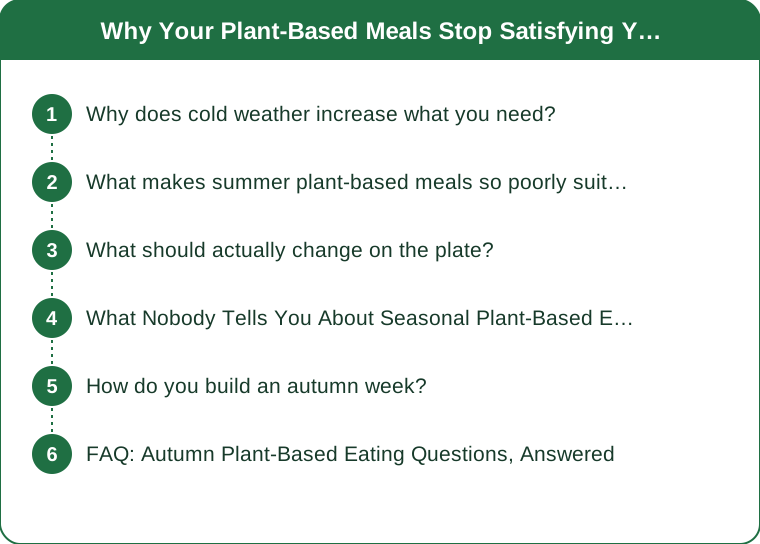
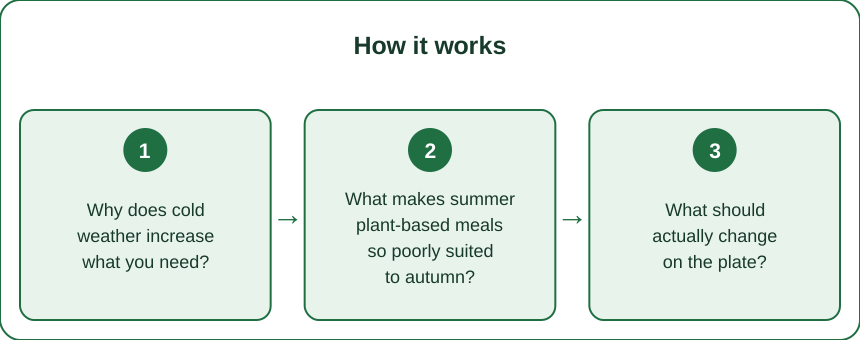
Why does cold weather increase what you need?
Two separate mechanisms, and both push in the same direction.
Thermoregulation costs energy. Maintaining core temperature in cool weather has a real metabolic price. It is not enormous, but across a day of commuting, walking, and sitting in an under-heated room, it adds up.
Appetite regulation shifts seasonally. Appetite tends to rise in cooler months — a well-documented pattern with plausible evolutionary logic. This means the hunger is real signaling, not a failure of willpower, which is worth saying because the usual response is to try to suppress it.
There is a third factor that is easy to miss: your activity often changes shape rather than amount. Summer activity is frequently long and low-intensity — walking, swimming, being outdoors. Autumn activity moves indoors and often becomes shorter and harder, which changes fueling requirements around sessions.
The practical implication: eating a bit more in autumn is a normal response to a genuine change, not something to correct.
What makes summer plant-based meals so poorly suited to autumn?
They are optimized for volume and hydration, which is exactly right in July and works against you in October.
Raw vegetables are mostly water. A large salad can be visually substantial and calorically small. In the heat, that combination is ideal. In the cold, it leaves a gap.
Cold food is less satiating than warm food. Warm meals produce a stronger and longer-lasting sense of fullness — part physiological, part psychological, and consistent enough to plan around.
Summer plant-based eating tends to be lower in fat. Fruit, salad, and grain-heavy meals are naturally lower fat, and fat is the most calorically dense macronutrient and a significant contributor to meal satisfaction.
Fiber without fat and protein empties faster than you think. A high-fiber, low-fat, low-protein meal produces good initial fullness that fades quickly. That “full then suddenly starving” pattern is the signature of this exact combination.
None of these are problems with plant-based eating. They are problems with summer-shaped meals in a different season.
What should actually change on the plate?
Five adjustments, in order of impact.
Cook the vegetables. Roasting, braising, and stewing concentrate flavor, break down volume, and make it much easier to eat a satisfying quantity. A roasted vegetable and lentil bowl and a raw salad with the same ingredients are entirely different meals in practice.
Add fat deliberately. Tahini, olive oil, nuts, seeds, avocado, coconut milk. This is the single biggest lever for plant-based satiety and the one most often under-used. A drizzle of tahini or a spoon of nut butter transforms a meal’s staying power.
Legumes as the base, not the garnish. Lentils, chickpeas, black beans, and split peas provide protein and fiber together and hold you far longer than grains alone. Autumn cooking suits them perfectly — soups, dals, stews, braises.
Protein at every meal, in a real quantity. Tofu, tempeh, seitan, legumes, or a protein supplement. Breakfast is the meal where this most often falls short, and a low-protein breakfast sets up a hungry day.
Serve it hot. Batch-cooked soups and stews reheat well and beat cold grain bowls comprehensively for satisfaction in cold weather.

What Nobody Tells You About Seasonal Plant-Based Eating
Autumn is genuinely the best season for plant-based cooking. Squash, root vegetables, brassicas, apples, pears, and every legume dish that is unappealing in August. The transition is an upgrade in ingredients, not a compromise.
Iron absorption gets more important in the cooler months for many people, as fatigue creeps in and it gets attributed to the weather. Pair iron-rich foods with vitamin C, and keep coffee and tea away from iron-rich meals by about an hour — tannins meaningfully reduce non-heme iron absorption.
Vitamin D deserves attention now, not in January. Sun exposure drops sharply in autumn, and vitamin D is limited in plant foods. It is worth discussing supplementation with your doctor before winter rather than in the middle of it.
Batch cooking works far better in autumn. Stews and soups improve overnight, freeze well, and reheat perfectly — none of which is true of a salad. The season rewards the exact habits that make plant-based eating easy.
Warm breakfasts change the whole day. Switching from a cold smoothie to oatmeal with nut butter and seeds is a small change that people consistently report as the biggest single improvement in autumn hunger.
Eating more in autumn is not a failure of discipline. It is a normal seasonal pattern. The goal is meals that satisfy you properly, not meals that keep you hungry more efficiently.
How do you build an autumn week?
A practical structure that removes most of the daily decisions.
Batch cook two things on the weekend. A big pot of something legume-based — a dal, a chili, a lentil soup — and a tray of roasted vegetables. Between them they form the base of most meals for several days.
Standardize a warm breakfast. Oats with nut butter, seeds, and fruit; or a savory option like a tofu scramble with beans. Decide once, repeat all week.
Keep a fat and a protein topping within reach. Tahini, toasted seeds, and a jar of chickpeas turn any base into a complete meal in thirty seconds.
Plan an afternoon snack rather than resisting one. If you are genuinely hungrier now, a planned snack with protein and fat is far better than an unplanned one at 4pm. Nuts, hummus and vegetables, or a slice of bread with nut butter.
Keep something in the freezer for the bad days. Portioned soup or stew. The days that derail plant-based eating are the tired, cold, late ones, and having a real meal ready fifteen minutes away is what carries you through them.
FAQ: Autumn Plant-Based Eating Questions, Answered
Am I eating too little protein or too few calories?
Both are possible and they present similarly. A quick check: track intake honestly for three days. If protein is under roughly 0.6 grams per pound of body weight or calories are well below your needs, that is likely the whole story. Plant-based eating makes it easy to under-eat both without noticing, particularly when meals are volume-heavy.
Should I take supplements as the seasons change?
B12 is essential year-round on a plant-based diet, not seasonal. Vitamin D becomes considerably more relevant as sunlight drops in autumn and winter. Iron and omega-3 status are worth checking if you feel persistently tired. Discuss with your doctor rather than guessing — this is general information, not medical advice.
Is it normal to gain a little weight in autumn on a plant-based diet?
Seasonal fluctuation of a few pounds is common across all diets and largely reflects increased appetite, less outdoor activity, and more energy-dense cooking. If it concerns you, the leverage is in keeping activity up and prioritizing protein and vegetables rather than in restricting the warm, satisfying meals that are making autumn eating work.
TL;DR:
- Cold weather raises energy needs and appetite, while cold, raw, low-fat summer meals are especially poor at satisfying you.
- Cook the vegetables — roasting and braising concentrate what raw preparation dilutes.
- Add fat deliberately: tahini, olive oil, nuts, seeds, avocado. It is the biggest satiety lever available.
- Make legumes the base rather than the garnish, and get real protein into every meal including breakfast.
- Batch cook soups and stews; autumn rewards exactly the habits that make plant-based eating easy.
The hunger is a signal that your meals are built for a season that ended. Switch to warm, fatty, legume-heavy cooking and autumn becomes the easiest plant-based season of the year.
Keep Reading
This article is for general informational purposes only and is not medical advice. Always consult a qualified health professional for guidance specific to you.