Why Plant-Based Eating Gets Harder the Week the Weather Turns
Quick Answer: Cool weather increases appetite for warm, dense, savoury food, and the plant-based summer default - salads, smoothies, cold grain bowls - stops satisfying almost overnight. What usually collapses first is protein, because summer plant protein tends to be scattered across cold dishes rather than centred in a hot one. The fix is to rebuild two or three warm anchor meals around legumes, tofu or tempeh, and to keep one hot protein cooked in the fridge at all times.
The same food that felt perfect three weeks ago now feels like eating a garnish for dinner.
That is a real physiological shift, not a willpower problem - and it has a straightforward structural fix.

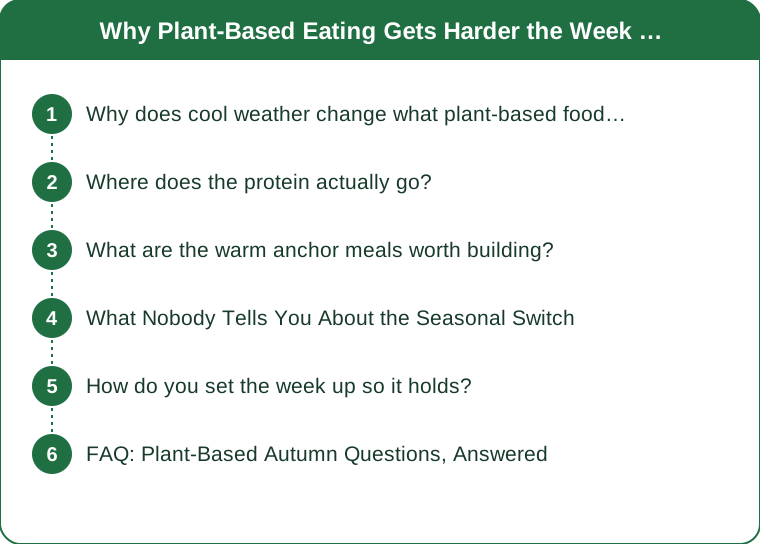
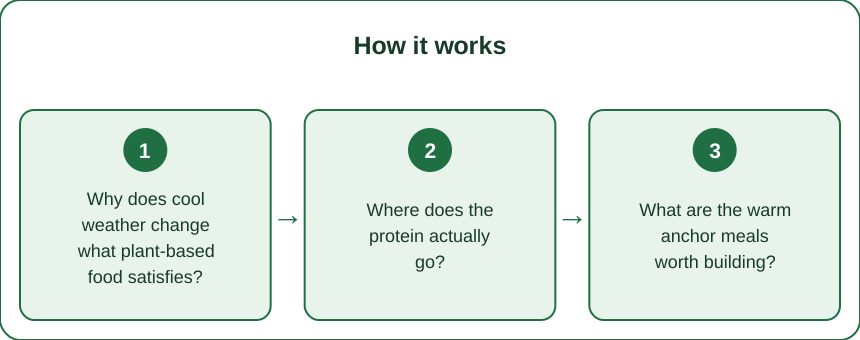
Why does cool weather change what plant-based food satisfies?
Warm food produces a stronger and faster sense of satisfaction than cold food of the same calorie content, which is why a hot bowl of lentil stew ends a meal in a way that a cold grain bowl does not.
Appetite genuinely increases as ambient temperature drops, partly through thermoregulation and partly through seasonal shifts in activity and daylight. You are not imagining being hungrier.
Summer plant-based patterns are unusually spread out. Protein comes from a handful of chickpeas here, some hemp seeds there, a scoop in a smoothie - it adds up on paper and it satisfies poorly.
Volume drops in cool weather too. Large raw salads are a summer behaviour, and when they go, so does a chunk of fibre and micronutrient intake that nothing has replaced yet.
And the transition is fast. It is usually one cool week rather than a gradual month, which is why it catches people who eat this way every year.
The result is a two-week window where intake gets worse before habits catch up, and that window is where most people conclude that plant-based eating stops working in autumn.
Where does the protein actually go?
Cold plant protein is easy: beans in a salad, tofu cubes, a protein smoothie, nuts on everything. These are low-effort and they disappear together when salads do.
Warm plant protein takes cooking, and that is the whole problem. Lentil stew, a tofu stir-fry and tempeh chilli all require a pot and twenty minutes in a way that a summer bowl does not.
People substitute carbohydrate for the missing protein without noticing. Warm and comforting maps to pasta, bread and potatoes far more easily than it maps to legumes, so the plate rearranges itself.
Protein needs do not drop in cool weather - if anything, more activity indoors and more resistance training in autumn pushes them slightly up.
A practical target is roughly 20 to 30 grams of protein per meal, which for plant-based eating means a legume, soy or seitan base rather than an accent.
And plant protein spread across the day beats concentrating it in one meal, because of how absorption and utilisation work - three meals at 25 grams outperforms one at 75.
What are the warm anchor meals worth building?
Lentil stew is the single best autumn plant-based anchor. A cup of cooked lentils delivers around 18 grams of protein, it costs very little, it freezes perfectly, and it improves overnight.
A chickpea and tomato braise with cumin and spinach takes twenty minutes and reheats for four days.
Tofu stir-fry with a peanut or miso sauce covers protein and fat in one pan; press the tofu, cube it and roast it at 425F for 25 minutes if you want texture without babysitting a wok.
Tempeh chilli carries the highest protein per serving of the group - around 30 grams per cup of tempeh - and the fermentation makes it easier on digestion than a straight bean chilli.
Split pea or black bean soup is the cheapest per gram of protein of anything on this list, and it is very hard to overcook.
Warm grain bowls with roasted vegetables and a legume base carry over the bowl format people already like, just heated - which is why they are the easiest transition meal.
Pick two or three, not seven. Rotation fatigue is a real thing, but so is decision fatigue, and the second one causes more failures in September than the first.

What Nobody Tells You About the Seasonal Switch
Iron absorption gets worse in autumn for a specific reason. Summer eating includes a lot of raw vitamin C - tomatoes, peppers, citrus, berries - alongside plant iron, and vitamin C dramatically increases non-heme iron absorption. Cooked autumn food often loses that pairing. Keep it deliberate: lemon juice on lentils, tomato in the bean pot, a bell pepper in the stir-fry.
Warm food masks under-eating for the first week and over-eating for the third. Density is harder to eyeball than volume, and stew calories are much less visible than salad calories.
B12 does not care what season it is, and neither does vitamin D - which matters more as daylight drops. If you supplement seasonally, autumn is when D becomes the one to be strict about.
Fibre often drops sharply in the transition as raw volume disappears, and the digestive complaints that follow get blamed on the beans rather than on the missing vegetables.
Batch cooking works far better in cool weather than in warm, because reheated stew is genuinely good and reheated salad is not. The habit that failed you in July is the right habit in September.
And the two-week adjustment window is real. Plan for it rather than concluding that something has gone wrong.
How do you set the week up so it holds?
Keep one hot protein cooked in the fridge at all times. A pot of lentils, a tray of roasted tofu or a batch of seasoned chickpeas turns any meal into a complete one in five minutes. This is the single highest-leverage habit here.
Cook a double batch of one anchor meal on the weekend and freeze half. Two hours on Sunday covers four dinners.
Keep one vitamin C source in every iron-containing meal, which is a small habit with a real absorption effect.
Do not abandon vegetable volume - move it to roasted. A sheet pan of roasted broccoli, squash and onions at 425F replaces the salad’s role and suits the weather.
Have a five-minute emergency meal ready: canned beans, frozen spinach, jarred sauce, a microwave rice pouch. It is not impressive and it prevents the toast-for-dinner slide.
Check protein honestly for one week using any tracking app, then stop. Most people find the gap is one meal rather than the whole day, and knowing which meal is the entire answer.
And warm the breakfast. Overnight oats out, porridge with soy milk and peanut butter in - this one swap alone recovers 15 to 20 grams of protein a day for many people.
FAQ: Plant-Based Autumn Questions, Answered
How much protein do I actually need on a plant-based diet?
General guidance sits around 0.8 grams per kilogram of body weight for sedentary adults, and plant-based eaters are often advised toward the higher end - roughly 1.0 to 1.2 - because of digestibility differences. Active people need more.
Is soy safe to eat every day?
Current evidence supports moderate daily soy intake as safe and often beneficial for most people. If you have thyroid conditions or a specific medical history, discuss it with your clinician. This is general information, not medical advice.
Why am I hungrier now than I was in July?
Cooler temperatures raise appetite through thermoregulation, and the shift toward cooked, lower-volume food removes some of the fullness that raw bulk was providing. Both effects are normal.
Do I need to combine proteins at every meal?
No. The complete-protein-at-every-meal idea was retired decades ago. A varied intake across the day covers amino acid needs, though including legumes and grains regularly is a sensible default.
What supplements matter most as the season changes?
B12 year-round, and vitamin D becomes more important as daylight drops. Iron, iodine and omega-3 are worth discussing with a clinician if your intake is narrow. This is general information, not medical advice.
Is it fine to eat the same three meals every week?
Yes, provided the ingredients vary somewhat. Rotation matters for micronutrients more than for macronutrients, and swapping the vegetable and the legume in a familiar template covers most of it.
TL;DR:
- Cool weather raises appetite and shifts satisfaction toward warm, dense food - the summer salad pattern stops working almost overnight.
- Protein is what collapses first, because summer plant protein is scattered rather than centred.
- Build two or three warm anchor meals: lentil stew, tofu stir-fry, tempeh chilli, bean soup.
- Keep one hot protein cooked in the fridge at all times; it is the highest-leverage habit of the season.
- Pair vitamin C with iron-containing meals, since autumn cooking often drops the raw sources that were doing that job.
- Swap overnight oats for warm porridge - it recovers 15 to 20 grams of protein for many people.
Expect a two-week adjustment window and plan for it. This is general information, not medical advice.
Keep Reading
This article is for general informational purposes only and is not medical advice. Always consult a qualified health professional for guidance specific to you.