Why Switching to Plant-Based Eating Often Causes Noticeable Workout Fatigue in the First Few Weeks
Quick Answer: A sudden shift to plant-based eating often temporarily lowers readily available iron and creatine stores, both of which support oxygen delivery and short-burst muscle energy during exercise, which is why many people notice real workout fatigue in the first two to four weeks even while eating enough total calories and protein — this typically resolves as the body adapts and intake is fine-tuned.
If workouts suddenly feel harder after going plant-based even though you’re eating enough, this is a known, temporary adjustment period, not a sign the approach doesn’t work for you.

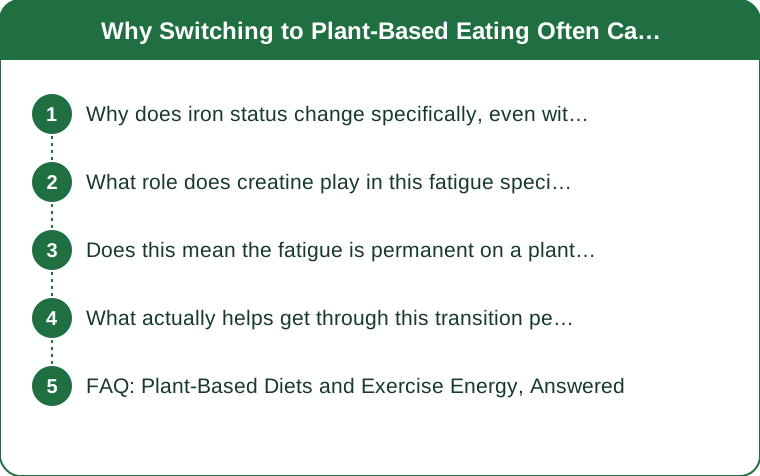
Why does iron status change specifically, even with adequate iron intake?
Plant-based iron (non-heme iron) is absorbed less efficiently than the heme iron in animal products, so total milligrams consumed can look adequate on paper while actual absorbed iron dips during the transition, directly affecting oxygen delivery to working muscles.
What role does creatine play in this fatigue specifically?
Dietary creatine comes almost entirely from animal products, so removing them drops the body’s creatine stores over several weeks, which measurably affects power output during short, high-intensity efforts like sprints or heavy lifts more than it affects steady endurance work.

Does this mean the fatigue is permanent on a plant-based diet?
No — most people’s energy normalizes within a few weeks as the body adapts, and deliberately pairing iron-rich plant foods with vitamin C, or supplementing creatine, can meaningfully shorten or reduce this adjustment window.
What actually helps get through this transition period faster?
Pairing iron-rich foods (lentils, spinach, fortified grains) with vitamin C sources at the same meal improves absorption significantly, and a low-dose creatine monohydrate supplement is a well-studied, low-risk option specifically for offsetting the drop in dietary creatine.
FAQ: Plant-Based Diets and Exercise Energy, Answered
How long does this fatigue period usually last?
Most people notice meaningful improvement within two to four weeks as absorption and training adaptation catch up, though individual timelines vary.
Should I reduce training intensity during this transition?
A modest, temporary reduction in high-intensity or heavy sessions is reasonable while the body adjusts, rather than pushing through at full intensity and risking poor recovery.
Is creatine supplementation necessary, or just intake changes enough?
Intake changes alone often help, but creatine supplementation is a well-researched, low-cost option specifically for people who do explosive or strength-based training and want to close the gap faster.
TL;DR:
- Plant-based iron and creatine stores drop temporarily during a sudden dietary transition
- This affects oxygen delivery and short-burst power more than steady endurance
- Most people’s energy normalizes within two to four weeks as the body adapts
- Pairing iron with vitamin C and considering creatine supplementation both help
Keep Reading
This article is for general informational purposes only and is not medical advice. Always consult a qualified health professional for guidance specific to you.