Why Calcium Is the Plant-Based Gap Almost Nobody Plans For
Quick Answer: Calcium is the nutrient most often quietly under-consumed on a plant-based diet, because dairy is a concentrated source that is difficult to replace by volume and because several plant sources have poor absorption. Spinach is high in calcium and almost none of it is absorbable due to oxalates, while kale, bok choy, and broccoli are absorbed very well. Fortified plant milk, calcium-set tofu, and low-oxalate greens are the practical backbone. Shaking fortified milk matters, because the calcium settles at the bottom of the carton.
The standard plant-based checklist covers B12, iron, omega-3, protein, and increasingly zinc and iodine, which this blog has written about.
Calcium is rarely on that list, and it is the one where the intuitive strategy fails most reliably, because the food people reach for first is the food that works worst.

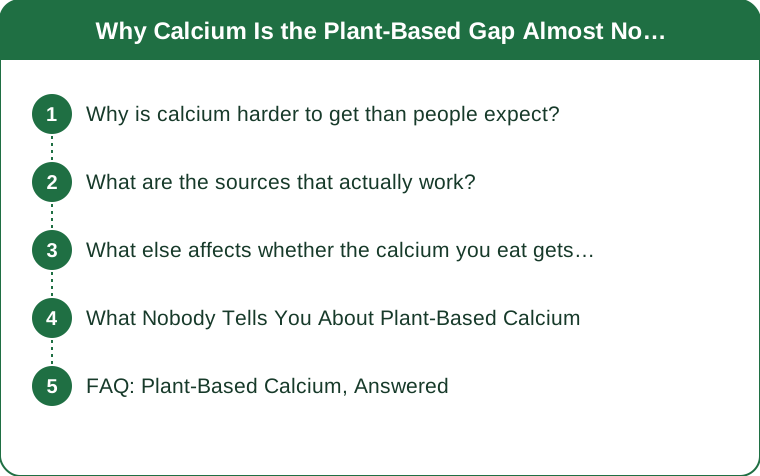
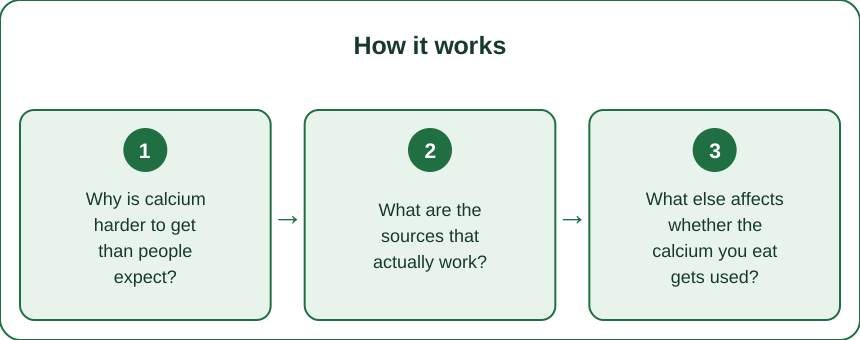
Why is calcium harder to get than people expect?
Because dairy is unusually concentrated and unusually well absorbed, and most substitutes are neither.
Dairy is a dense package. A serving delivers a large amount of calcium in a small volume with good absorption, roughly a third of what is present. Replacing that by volume with vegetables requires eating a genuinely large quantity.
Absorption varies enormously between plant sources. This is the part that catches people out. The calcium content listed on a food tells you nothing useful on its own, because what matters is how much of it you can actually take up.
Oxalates are the main blocker. Spinach, Swiss chard, beet greens, and rhubarb are high in oxalic acid, which binds calcium into an insoluble compound. Spinach is frequently listed as a calcium source and the absorption rate from it is very low, in the region of a few percent. Effectively, spinach is not a calcium source in practical terms, despite the number on the label.
Phytates in beans and grains reduce absorption moderately. Less dramatically than oxalates, and enough to matter across a diet built largely on legumes and grains. Soaking, sprouting, and fermenting reduce phytate content meaningfully.
Low-oxalate greens are absorbed better than dairy. Kale, bok choy, broccoli, cabbage, and watercress have absorption rates around fifty to sixty percent, considerably higher than dairy’s thirty or so. They contain less calcium per serving, and what is there goes in efficiently.
So the ranking that matters is content multiplied by absorption, and it looks quite different from the ranking by content alone. This is why the intuitive choice of a big bowl of spinach achieves almost nothing while a smaller portion of bok choy achieves a lot.
What are the sources that actually work?
Four categories, in rough order of practical usefulness.
1. Fortified plant milks. The single most practical source, delivering an amount comparable to dairy per serving with good absorption. Critical detail: fortification calcium settles at the bottom of the carton, and studies have found substantial variation in how much you actually get depending on whether the carton was shaken. Shake it properly every time. Also check the label, since not all plant milks are fortified and organic ranges frequently are not.
2. Calcium-set tofu. Tofu made with calcium sulphate as the coagulant is an excellent source, delivering a large amount per serving with good absorption. Tofu set with magnesium chloride, sometimes labelled nigari, contains far less. The ingredients list tells you which you have bought, and the difference between two similar-looking blocks is substantial.
3. Low-oxalate greens. Kale, bok choy, broccoli, cabbage, watercress, and rocket. Excellent absorption, moderate content, and easy to eat regularly. Bok choy in particular is under-used.
4. Everything else, in smaller contributions. Fortified orange juice, tahini and sesame seeds, almonds, dried figs, white beans, tempeh, and fortified breakfast cereals. Each contributes a modest amount, and together they add up across a day.
A note on what does not count. Spinach, chard, and beet greens are excellent foods with almost no usable calcium. Do not count them, and keep eating them for everything else they provide.

What else affects whether the calcium you eat gets used?
Several things, and vitamin D is the one that matters most.
Vitamin D governs absorption. Without adequate vitamin D, calcium absorption drops substantially regardless of intake. This is a general population issue rather than a plant-based one specifically, and it becomes more acute in autumn and winter when sunlight-driven synthesis falls to near zero at higher latitudes. Many public health bodies recommend supplementation over the darker months. Vitamin D3 from lichen is a plant-based option, since most D3 is derived from lanolin.
Protein intake supports bone health rather than harming it. The old idea that high protein leaches calcium from bone has not held up well. Adequate protein is associated with better bone outcomes, and low protein intake is a genuine risk factor. Plant-based eaters who are also under-eating protein have two problems rather than one.
Sodium increases calcium losses. High sodium intake increases urinary calcium excretion. This is a moderate effect and it favours a diet that is not built heavily on processed foods.
Vitamin K2 and magnesium are involved in bone metabolism. K2 is limited in plant-based diets other than through natto and some fermented foods. The evidence base is less settled than for calcium and vitamin D, and it is enough to be worth knowing.
Weight-bearing exercise matters as much as diet. Bone responds to load. Resistance training and impact activity are strong drivers of bone density, and no dietary strategy substitutes for them.
Why this matters more for some people. Some research has found lower bone mineral density and higher fracture rates in vegans compared to omnivores, with the difference substantially attenuated when calcium and protein intake are adequate. In other words the risk appears to be about intake rather than about the diet pattern itself, which is a fixable problem. This is general information, not medical advice, and anyone concerned about bone health should discuss it with a doctor or a registered dietitian.
What Nobody Tells You About Plant-Based Calcium
The carton shaking issue is real and it is large. Calcium carbonate is not soluble and settles. Testing has found that the last portion poured from an unshaken carton can contain several times more calcium than the first. If you pour from the top of the carton every morning, you may be getting a fraction of what the label says.
Organic plant milks are often unfortified. In several markets, organic certification restricts added vitamins and minerals. Someone who switched to an organic oat milk for other reasons may have removed their main calcium source without realising.
Calcium and iron compete for absorption. Taking a calcium supplement alongside an iron-rich meal reduces iron uptake, which is already a concern on plant-based diets. Separate them by a couple of hours, and this blog has covered the related point about coffee timing undercutting iron.
Cooking changes oxalate content. Boiling high-oxalate greens and discarding the water removes a meaningful share of the oxalates. It does not turn spinach into a good calcium source, and it helps.
Supplements are less effective than food in one specific way. Calcium is absorbed better in smaller doses, so a single large supplement is used less efficiently than the same amount spread across meals. If supplementing, split the dose.
Hard tap water contributes more than people expect. In hard water areas, drinking water can supply a non-trivial amount of calcium across a day. It is not a strategy, and it is a reason intake varies by region.
Teenagers and people over fifty have higher requirements. Bone is being built in adolescence and lost after menopause, and requirements reflect that. A plant-based calcium strategy that works for a thirty-year-old may be insufficient for a fifty-five-year-old, which is exactly the group most likely to have been eating this way the longest.
FAQ: Plant-Based Calcium, Answered
Is spinach a good source of calcium?
No, despite the high number on the label. Spinach is very high in oxalates, which bind calcium into a form the body cannot absorb, and the absorption rate is only a few percent. Kale, bok choy, and broccoli are absorbed far better.
How much calcium does fortified plant milk provide?
Usually an amount comparable to dairy, with one important caveat: the calcium settles at the bottom of the carton. Shake it thoroughly every time, or you may get a small fraction of what the label states.
Do I need a calcium supplement on a plant-based diet?
Not necessarily, if you regularly eat fortified plant milk, calcium-set tofu, and low-oxalate greens. Vitamin D is more commonly the limiting factor, particularly in autumn and winter. Discuss it with a doctor or dietitian. This is general information, not medical advice.
TL;DR:
- Calcium is the plant-based gap most people never check, because dairy is concentrated and well absorbed and hard to replace by volume.
- Spinach and chard are high in calcium and almost none of it is absorbable. Kale, bok choy, and broccoli beat dairy on absorption rate.
- Fortified plant milk and calcium-set tofu are the practical backbone. Check the coagulant on the tofu label.
- Shake the carton properly. The calcium settles at the bottom and the difference is several-fold.
Check two labels tonight: whether your plant milk is fortified, and whether your tofu is set with calcium sulphate.
Keep Reading
This article is for general informational purposes only and is not medical advice. Always consult a qualified health professional for guidance specific to you.