Why Restaurant Menus Make Eating Plant-Based Harder Than It Actually Needs to Be
Quick Answer: Most restaurant menus are organized around a protein-centered format that simply wasn’t built with plant-based eating in mind, which means the fastest way to find viable options is often to scan the side dishes and vegetable preparations first, then ask about substitutions — rather than scanning the entree list, where you’ll find the fewest options.
You’re not bad at ordering plant-based food — the menu itself is working against you, and once you see why, the whole process gets noticeably faster.

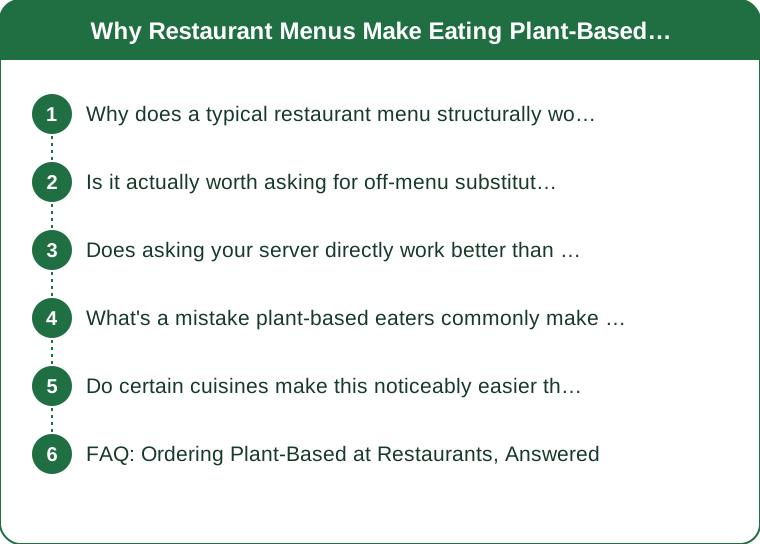
Why does a typical restaurant menu structurally work against plant-based ordering?
Most menus are organized around a central protein (chicken, beef, fish) with sides built to complement it, which means the entree section — the first place most people look — is exactly where plant-based options are scarcest. Scanning appetizers, sides, and salads first usually surfaces far more workable options faster than scrolling the entree list looking for the one exception.
Is it actually worth asking for off-menu substitutions, or does that just slow things down?
It’s usually worth it — many kitchens can swap a meat or dairy component for an already-stocked vegetable or grain side without much extra effort, since the ingredients typically already exist in the kitchen for other dishes. A specific, simple ask (‘could I get the grain bowl without the chicken, with extra roasted vegetables instead’) tends to get a faster yes than a vague one.
Does asking your server directly work better than trying to figure it out from the menu alone?
Often, yes — servers frequently know about hidden animal-derived ingredients (chicken stock in a soup, fish sauce in a dressing) that aren’t listed on the menu itself, since menus rarely disclose every cooking ingredient. A quick, specific question before ordering avoids the more common disappointment of a dish that looked plant-based but wasn’t.

What’s a mistake plant-based eaters commonly make when ordering out?
Assuming a dish is automatically plant-based because it’s vegetable-forward, without checking for butter, cream, cheese, or animal-based stocks and sauces, is one of the most common ordering mistakes — a vegetable side can still be finished with butter or chicken broth in many kitchens, so a specific ask still matters even for produce-heavy dishes.
Do certain cuisines make this noticeably easier than others?
Generally, yes — cuisines built around vegetable, legume, and grain staples as a default rather than an exception (many South and Southeast Asian, Middle Eastern, and Ethiopian menus, for example) tend to have more naturally plant-based dishes without modification, compared to menus built around a Western protein-plus-two-sides format.
FAQ: Ordering Plant-Based at Restaurants, Answered
Is it rude to ask for multiple substitutions on one dish?
No — most restaurants are used to dietary modification requests, and a clear, specific ask is generally easier for kitchens to accommodate than a vague or last-minute one.
Should you call ahead for restaurants that seem to have limited options?
For smaller or less flexible kitchens, calling ahead can be genuinely useful, since it gives the kitchen time to prepare an option rather than scrambling during a busy service.
Are appetizer-only meals a reasonable plant-based strategy at a difficult restaurant?
Yes — ordering two or three appetizers or sides instead of a single entree is a commonly used, practical workaround when the entree section offers little.
TL;DR:
- Restaurant menus are structured around protein-centered entrees, which is why the entree section has the fewest plant-based options
- Scanning sides and appetizers first usually surfaces more usable options faster
- Hidden animal ingredients (stock, fish sauce, butter) often aren’t listed, so asking directly matters
- Cuisines built around vegetables and legumes as a default tend to be easier to navigate
The skill isn’t finding a perfect vegan entree — it’s reading the menu in a different order and asking one specific, well-aimed question.
Keep Reading
This article is for general informational purposes only and is not medical advice. Always consult a qualified health professional for guidance specific to you.