Why Plant-Based Bloating Hits Hardest in the First Month (and When It Actually Stops)
Quick Answer: Plant-based bloating in the first few weeks is almost always caused by a sudden jump in fiber intake outstripping your gut bacteria’s ability to process it, and for most people it settles down within 2 to 4 weeks as the microbiome adapts.
If you switched to plant-based eating and felt more bloated, not less, you’re not doing it wrong — you skipped the adjustment period nobody warns you about.

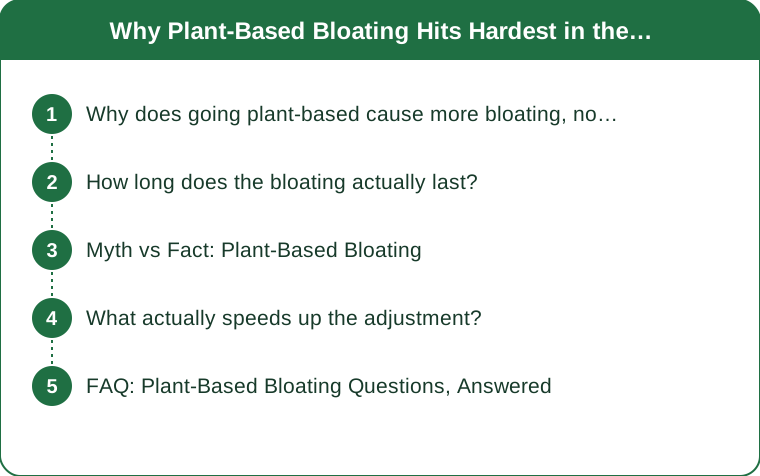
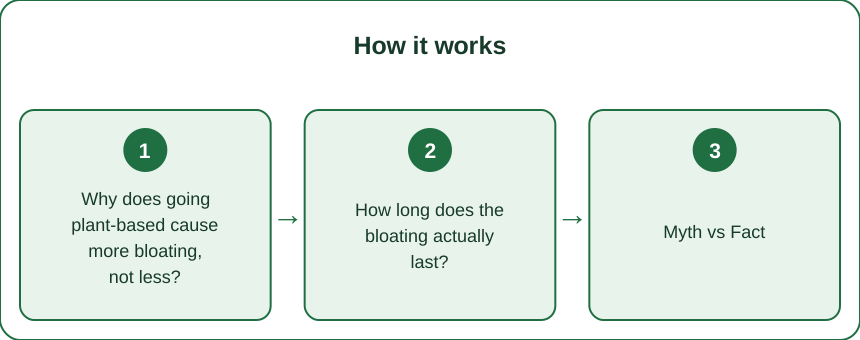
Why does going plant-based cause more bloating, not less?
Fiber intake often triples or quadruples overnight when someone switches to plant-based eating, and the gut bacteria responsible for fermenting that fiber need time to build up their numbers to handle the new load.
In the meantime, undigested fiber ferments and produces gas, which is uncomfortable but is actually a sign your gut microbiome is adjusting rather than a sign of intolerance.
How long does the bloating actually last?
For most people, bloating peaks in the first 1 to 2 weeks and noticeably improves by week 3 or 4 as fiber-fermenting bacteria populations expand to match intake.
If bloating hasn’t improved at all by week 6, it’s worth looking at specific trigger foods (beans, cruciferous vegetables, onions) rather than assuming it’s just an adjustment issue.

Myth vs Fact: Plant-Based Bloating
Myth: bloating means your body can’t handle plant-based eating. Fact: it usually means your fiber intake increased faster than your gut bacteria could adapt — a timing problem, not a compatibility problem.
Myth: you should cut fiber back down to stop the bloating. Fact: gradually increasing fiber over 2 to 3 weeks, rather than dropping it, is what actually trains the gut to process it comfortably long-term.
What actually speeds up the adjustment?
Increasing fiber gradually over 2 to 3 weeks instead of all at once gives gut bacteria time to build up, which is the single biggest lever for reducing adjustment-period bloating.
Cooking beans and cruciferous vegetables thoroughly, and rinsing canned beans well, also reduces the specific sugars that trigger gas during this transition window.
FAQ: Plant-Based Bloating Questions, Answered
Should I take a probiotic during the transition?
A probiotic can help some people, but it’s not required — most gut adaptation happens naturally within a few weeks as your own bacteria populations shift with your new diet.
Is it normal to feel more bloated some days than others?
Yes, bloating during this period is rarely linear; a heavier bean or cruciferous-vegetable day will bloat more than a lighter day, even within the same adjustment window.
When should I see a doctor about bloating?
If bloating comes with severe pain, unintended weight loss, or persists unchanged for more than 6 to 8 weeks, it’s worth ruling out other causes with a professional. This is general information, not medical advice.
TL;DR:
- First-month plant-based bloating is usually a fiber-adjustment issue, not a sign the diet doesn’t work for you
- It typically peaks in week 1-2 and improves by week 3-4
- Increasing fiber gradually, rather than all at once, is the fastest way through it
- Persistent bloating past 6-8 weeks is worth discussing with a doctor
Give your gut a few weeks before deciding plant-based isn’t for you — the discomfort is usually a phase, not a verdict.
Keep Reading
This article is for general informational purposes only and is not medical advice. Always consult a qualified health professional for guidance specific to you.