The Plant-Based Breakfast Mistake That Leaves You Starving by 10 AM
Quick Answer: The most common cause of mid-morning hunger on a plant-based breakfast is too little protein relative to carbohydrate — oatmeal, toast, and fruit are carb-heavy and digest quickly, so without a solid plant protein source (15-20g), blood sugar and satiety both drop within two to three hours.
The breakfast often looks perfectly healthy — it’s the ratio, not the ingredients themselves, that’s the problem.

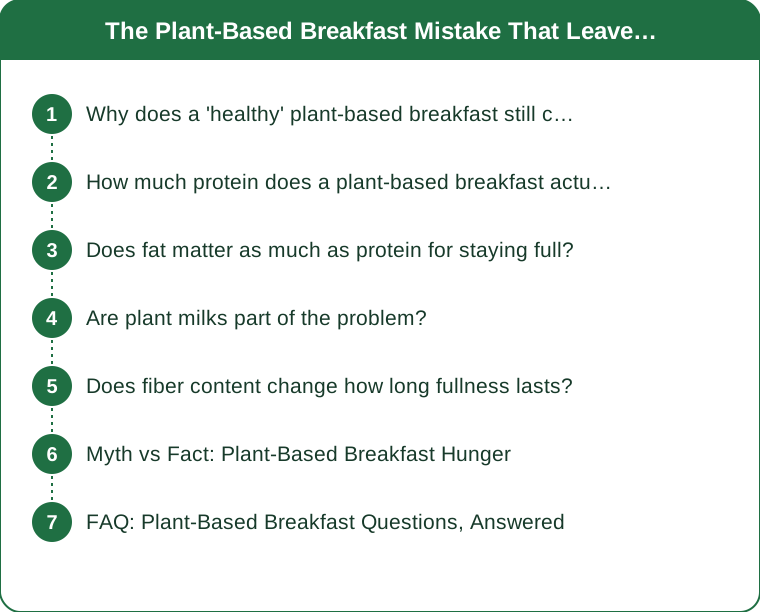
Why does a ‘healthy’ plant-based breakfast still cause hunger crashes?
Most default plant-based breakfasts (oatmeal, toast, smoothies, fruit) are carbohydrate-dominant with relatively little protein or fat, which means they digest fast and don’t sustain blood sugar or fullness signals much past the two-hour mark, even when calories look adequate on paper.
How much protein does a plant-based breakfast actually need?
Aiming for roughly 15-20 grams of protein at breakfast — from tofu, tempeh, a protein-fortified plant milk, seitan, edamame, or a plant protein powder blended in — tends to extend satiety by a couple of hours compared to a protein-light version of the same meal.
Does fat matter as much as protein for staying full?
It plays a supporting role — adding a source of fat like nut butter, seeds, or avocado slows digestion and blunts the blood sugar spike from the carbohydrate portion, which helps smooth out the crash even when protein alone isn’t maxed out.

Are plant milks part of the problem?
Sometimes — many popular plant milks (oat, rice, some almond blends) are quite low in protein compared to dairy or soy milk, so a cereal-and-plant-milk breakfast can be lower in protein than it appears. Checking the label for at least 6-8g protein per cup is a quick fix.
Does fiber content change how long fullness lasts?
Yes — high-fiber additions like chia seeds, ground flax, or berries slow gastric emptying and support more stable blood sugar, working alongside protein and fat rather than replacing the need for either.
Myth vs Fact: Plant-Based Breakfast Hunger
Myth: eating more food volume fixes the hunger. Fact: adding more oatmeal or fruit just adds more fast-digesting carbohydrate, which can make the crash arrive at the same time, just with more calories consumed getting there.
Myth: this is a sign plant-based eating doesn’t ‘work’ for you. Fact: it’s a ratio problem, not a diet-pattern problem — the same crash happens on any protein-light, carb-heavy breakfast regardless of whether it’s plant-based.
FAQ: Plant-Based Breakfast Questions, Answered
What’s a quick 20g-protein plant-based breakfast that isn’t a smoothie?
Scrambled tofu with nutritional yeast and a side of whole-grain toast typically lands close to 20g, with minimal prep time.
Does timing (how soon after waking) matter for the hunger crash?
Less than composition does — a well-balanced breakfast eaten an hour later still outperforms an unbalanced one eaten immediately upon waking.
Can this same hunger pattern happen at other meals too?
Yes, the protein-to-carb ratio principle applies at lunch and dinner as well, though breakfast tends to be where it’s most commonly overlooked.
TL;DR:
- Mid-morning hunger usually traces back to too little protein relative to carbs at breakfast
- Aim for roughly 15-20g plant protein to meaningfully extend fullness
- Adding fat and fiber slows digestion and smooths out the blood sugar response
- Check plant milk labels — many are lower in protein than they look
Tomorrow, try adding one solid protein source to your usual breakfast without changing anything else, and see if the 10 AM crash actually moves later.
Keep Reading
This article is for general informational purposes only and is not medical advice. Always consult a qualified health professional for guidance specific to you.